3D Mandala Flower: A Versatile Design Element for Modern Creative Work
Mandala patterns have long held a place in both spiritual traditions and visual design for their symmetry, complexity, and meditative quality. When translated into a three-dimensional form, the 3D Mandala Flower becomes something else entirely: a digital asset that bridges geometry, organic form, and spatial depth. For designers, content creators, and visual storytellers, this type of resource offers more than just ornamental value. It provides a structural foundation for branding, motion graphics, product visualization, and immersive experiences. Understanding what makes a 3D Mandala Flower distinct, how it performs across different applications, and where its real strengths lie can help you decide whether it fits into your workflow or creative pipeline.
What a 3D Mandala Flower Actually Is
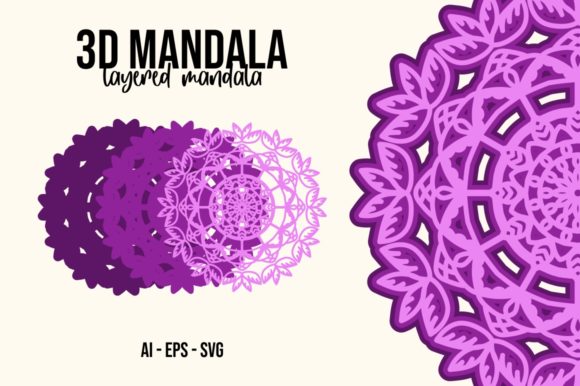
A 3D Mandala Flower is a digitally modeled, three-dimensional interpretation of traditional mandala motifs rendered in the form of a flower. Unlike flat vector mandalas or hand-drawn illustrations, this asset exists in virtual space with depth, texture, and volumetric presence. It typically features concentric layers of petals, geometric rings, and intricate cutouts that radiate from a central point. The result is a structure that can be rotated, lit, animated, and viewed from any angle, offering a level of flexibility that two-dimensional assets cannot match.
These models are commonly created using software such as Blender, Cinema 4D, or Maya, and are often provided in formats like OBJ, FBX, GLB, or STL. Many are also optimized for real-time rendering environments, making them usable in game engines, augmented reality applications, and web-based 3D viewers. The best examples of a 3D Mandala Flower maintain clean topology, consistent UV mapping, and modular construction, which allow them to be repurposed without extensive rework.
Symmetry and Structural Precision
The defining feature of any mandala is radial symmetry, and a 3D Mandala Flower takes this to a higher level of precision. Each petal, ring, or carved element is typically mirrored across multiple axes, creating a visually balanced form. This symmetry is not just aesthetic; it simplifies animation workflows. For example, if you need a rotating mandala or a blooming animation, the uniform structure ensures that motion remains smooth and visually coherent without unexpected distortions.
Depth and Layering
In a 2D mandala, depth is suggested through shading and line weight. In a 3D Mandala Flower, depth is literal. Layers of petals can sit at different distances from the center, overlapping one another in real space. This allows for lighting effects such as rim light, subsurface scattering, or cast shadows that reveal the true dimensionality of the form. For product designers or visualizers, this means the asset can be integrated into scenes with realistic lighting without looking flat or pasted in.
Customizability and Modularity
Many 3D Mandala Flower assets are built as modular components. The central bloom, outer rings, and base can sometimes be separated, recolored, or rearranged. This is particularly useful when the asset needs to be adapted for different contexts, such as a brand identity element, a UI decoration, or a physical product prototype. The ability to isolate parts also simplifies texturing: you can apply a glossy finish to the outer petals and a matte finish to the inner core, or map a gradient across specific rings.
Branding and Visual Identity
A 3D Mandala Flower can serve as a distinctive logo element or brand marker. Its geometric precision lends itself to contemporary tech and wellness brands, while its floral associations make it suitable for beauty, fashion, and lifestyle identities. When rendered with metallic or glass materials, it communicates a premium feel. When textured with natural fibers or organic colors, it grounds a brand in sustainability or artisanal values. For marketers and brand strategists, having a single 3D asset that can be rendered in different styles offers flexibility without requiring a new design from scratch each time.
Motion Graphics and Title Sequences
Because the asset exists in three dimensions, it can be animated in ways that flat graphics cannot. A 3D Mandala Flower can rotate, unfold, pulse, or fragment as part of a title sequence or transitional element. Motion designers often use such assets to create hypnotic, flowing visuals that hold viewer attention. With proper rigging, even complex animations like petal-by-petal blooming become feasible. The key consideration here is topology: an asset with clean edge loops and appropriate polygon count will deform predictably, while a poorly constructed model may break under animation rigging.
Product Visualization and Merchandise Design
For entrepreneurs and small business owners who develop physical products such as jewelry, home décor, or laser-cut ornaments, a 3D Mandala Flower can be used as a prototyping reference. The model can be imported into slicing software for 3D printing or used to generate toolpaths for CNC engraving. Because the geometry is exact, you can test scale, proportion, and negative space before committing to material. This reduces waste and iteration cost. For print-on-demand or merchandise creators, the same asset can be rendered for mockups, packaging visuals, and social media content.
Educational and Meditative Content
Educators and content creators who produce mindfulness, meditation, or therapeutic material often use mandala imagery to facilitate focus and relaxation. A 3D Mandala Flower adds an immersive dimension to such content. In a guided meditation video, a slowly rotating mandala with subtle lighting shifts can serve as a visual anchor. In an interactive app, users might rotate or zoom into the model themselves. The sense of depth and presence that a 3D version provides is more engaging than a static image, and it can be produced once and reused across multiple pieces of content.
Who Benefits Most from This Asset
While a wide range of creative professionals can find value in a 3D Mandala Flower, certain groups will see the most consistent return:
- Motion designers and video editors who need loopable, symmetrical elements for transitions, backgrounds, or lower thirds.
- Brand identity designers looking for a cohesive visual anchor that can be adapted across digital, print, and spatial media.
- E-commerce and product marketers who create mockups for home goods, jewelry, or spiritual products.
- Web and UI designers working on interactive experiences where a 3D element adds engagement without overwhelming the interface.
- Educators and wellness content creators who produce visual aids for meditation, yoga, or therapeutic sessions.
Freelancers and independent creators will appreciate the asset's reusability. A single 3D Mandala Flower can appear in a social media campaign, a website hero section, and a printed brochure with different renders. For agencies and studios, having a library of such modular assets reduces production time on client projects that require ornamental or geometric elements.
Quality Indicators to Look For
Not all 3D Mandala Flower assets are created equal. When evaluating a specific model or collection, consider the following factors:
- Topology and edge flow. Clean quads and proper edge loops are essential for deformation and subdivision. Avoid assets with excessive triangles or degenerate geometry.
- UV mapping. Well-laid UVs allow for seamless texturing. Check whether the UV islands are arranged logically and whether the resolution is consistent across the model.
- Polygon count. The ideal count depends on your use case. For real-time applications like web viewers or AR, lower polygon counts with good normal maps are preferable. For rendered stills or film, higher detail is acceptable.
- Format compatibility. Confirm that the asset is available in a format your pipeline supports. Common formats include FBX, OBJ, GLTF, and native files for specific software.
- Texture and material quality. If textures are included, assess whether they are tileable, whether maps (normal, roughness, metallic, opacity) are present, and whether the materials are set up for a standard PBR workflow.
Assets that score well on these criteria will integrate into your workflow with minimal friction. Those that fall short may require significant cleanup, which can offset the time saved by using a pre-built model.
Practical Considerations and Possible Limitations
While a 3D Mandala Flower offers considerable creative flexibility, it is not a universal solution. One limitation is that heavily detailed models with fine cutouts and thin geometry can cause issues in 3D printing, where overhangs and delicate features may require support structures or redesign. If your primary goal is physical fabrication, you should verify the model's manifold status and wall thickness before production.
Another consideration is file size. High-polygon mandala flowers with high-resolution textures can become large files, which may be problematic for web delivery or real-time applications. If you are building for browser-based 3D experiences, look for lightweight versions or be prepared to decimate and bake textures.
Additionally, the aesthetic of a 3D Mandala Flower is quite specific. It works well in spiritual, geometric, ornamental, or nature-inspired contexts, but it may feel out of place in minimalist, industrial, or purely abstract design systems. Consider whether the visual language of the mandala aligns with your brand or project before committing to it as a core element.
How to Use a 3D Mandala Flower Effectively
To get the most value from this type of asset, plan for reuse from the start. Establish a library of variations, such as different material presets, color palettes, and scaling options. Because the geometry remains the same, you can render multiple looks by swapping textures or adjusting lighting setups. This approach works especially well for content calendars where you need consistent visual identity across multiple posts or videos.
Consider pairing the asset with complementary elements like soft particle systems, lens flares, or depth-of-field effects to enhance its dimensionality. In motion projects, subtle rotation and slow scaling can create a hypnotic effect without requiring complex animation rigs. For still renders, experiment with rim lighting and backlighting to emphasize the layered structure of the flower.
If you are using the asset in a collaborative environment, document its scale and intended orientation. A 3D Mandala Flower modeled at one scale may appear too large or too small when imported into a scene with other objects. Setting a consistent reference early prevents downstream adjustments.
Long-Term Value and Reusability
One of the strongest arguments for investing in a high-quality 3D Mandala Flower is its longevity. Unlike a trend-driven graphic element that may feel dated after a season, the mandala's geometric and symmetrical nature lends it a timeless quality. A well-crafted model can be used for years across multiple projects, with only texture and material updates to keep it current. For studios and independent creators alike, this makes it a sound addition to a digital asset library.
The asset also scales across media. The same model that appears in a branded video can be exported for use in a printed catalog, embedded in a web experience, or adapted for a physical product. This kind of cross-medium utility is rare and valuable, especially for small teams who cannot afford to produce bespoke assets for every channel.
Ultimately, whether a 3D Mandala Flower fits your needs depends on the kind of work you do and the visual language you want to establish. For those who regularly produce content that benefits from symmetry, depth, and ornamental detail, it offers a reliable and flexible building block. For those working in ultra-minimalist or purely functional design, it may be more than needed. Assess your project pipeline, evaluate the quality of the specific asset you are considering, and test it in your target environment before committing to a full workflow integration. When chosen thoughtfully, a 3D Mandala Flower can become a staple element that serves multiple projects with minimal modification.